
Failed to load content. Please try again.
Meet Osprey’s Vietnam Team: The Sample Room
As we celebrate 50 years of Osprey, we are excited to highlight the amazing team behind our Vietnam operations. Having an in-house prototyping team is rare in the soft goods world. Learn about our pattern makers and sewists through the eyes of Hanh, Osprey’s Design Developer.
Visit other floors at the Osprey Vietnam office: Operations & Quality Control; Design & Graphics
7 min read
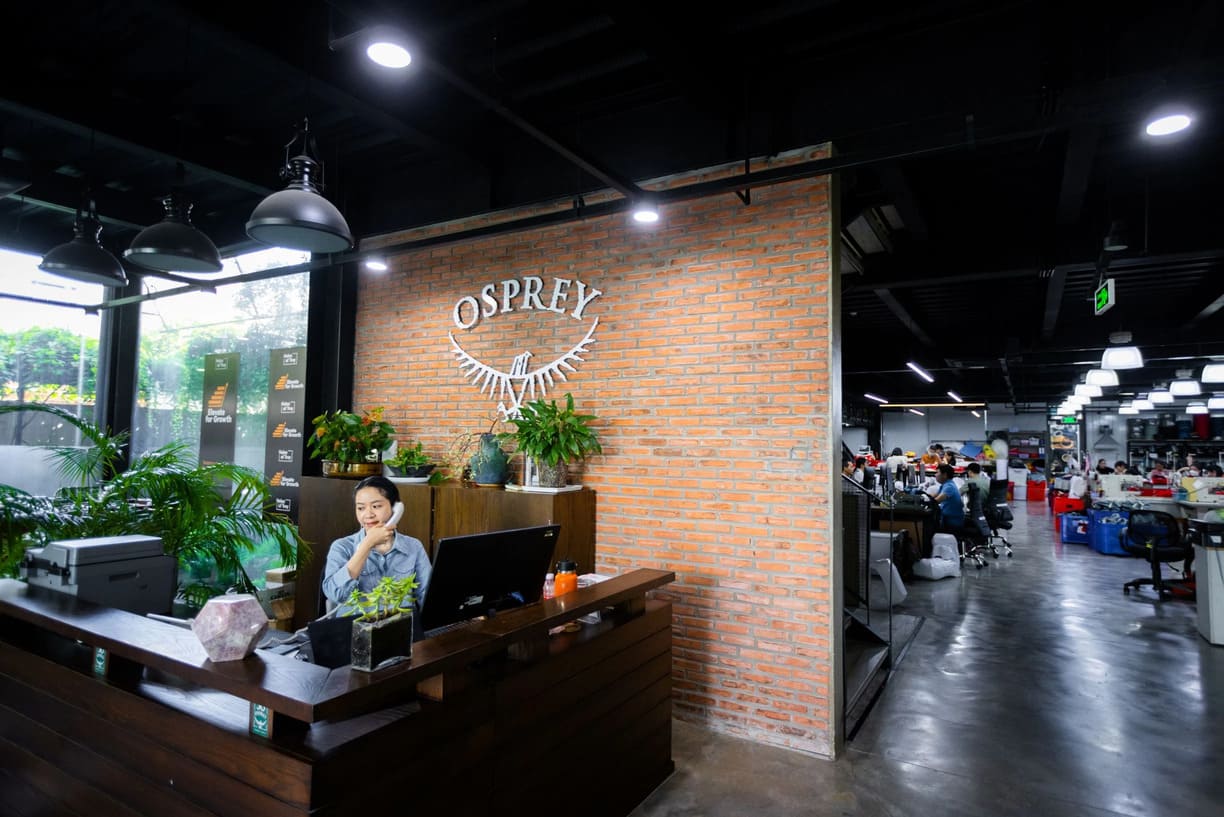
It is a humid and bright day in Bình An, a subset of District 2 in Ho Chi Minh City. The western edge of the district is defined by the Saigon river which threads through a tapestry of over ten million people, obscured by a dense organism of buildings. The best way to move through the busy streets is on a motorbike, dodging to the front of traffic to join forces with other scooters and bikes, almost brushing toes.
Osprey’s Vietnam office is on a tight, quiet street between the Saigon River and the bustling main thoroughfare of Bình An. In the morning I stop at the small coffee cart tucked next to the office to order a cà phê sữa đá–strong iced coffee with sweetened condensed milk. Two small dogs emerge from under the shade of the company van to bark at me as I walk through the tall gate and head into the office.

The building is modern and industrial with a wide, open staircase connecting three floors with floods of natural light. It may sound odd, but I can smell the pack materials beyond reception in the sample room where a team of around 25 people are hard at work patterning and assembling prototypes under the hum of industrial sewing machines. Making samples in-house is an anomaly in the soft goods production world, where most companies prototype at factories.
The sample room is managed by Hanh, Osprey’s Design Developer. Her presence is strong and grounded, informed by years of experience. I cannot understate her importance to the pulse of production flow at Osprey. Her role requires management of people, materials, and development schedules while remaining adaptable to the many moving pieces of a global team. I sat down with her on a Friday morning during a brief lull in the pace of the sample room to learn more about her story at Osprey.

Hanh was initially hired as a Quality Control (QC) Inspector, but was soon offered a job in development. When I asked her about the moment she was offered the job, she smiled. “When they interviewed they said, ‘You do a job for two years and then you stop.’ and I said, ‘It depends on the company and not me. If you have a good environment, a chance for me to study, and a chance for a promotion, I will stay long.’” She has been at Osprey for thirteen years now.
“I had a lot of chances to study from Mike and Quynh,” she continued, referencing Osprey’s founder Mike Pfotenhauer and Le NhuQuynh, the design and innovation manager. “In here you can talk about your ideas. Maybe sometimes they’re crazy, but sometimes they’re good. That’s what’s exciting about design. Sometimes you can’t sleep because you try to think of a solution. We fail many times but at least we have a solution that was made here. At Osprey you really input your ideas into the product. It’s not very common.”
The day-to-day workload in the sample room varies throughout the production calendar. Most designs go through around eight rounds of samples before moving to the factory, although some projects are closer to thirty rounds. On top of managing physical production in the sample room, Hanh works with Osprey’s team of designers across the globe. Under Hanh’s leadership, the dynamic nature of the sample room is quite impressive. During the busiest times of year there are more than 100 product samples coming out of the sample room within a span of two or three weeks.

When she first began managing the sample room eight years ago, Hanh realized there was a lot of extra material in the office going unused. This surplus, paired with the ebb and flow of workload in the sample room, sparked an idea. “I thought if we could save the labor cost and save the material then we could make some charity packs. When we started around five years ago we only finished around three hundred. Last year we finished two thousand.”
The project includes multiple companies now, and has also inspired some of Osprey’s suppliers to donate foam, fabric, and hardware and to print special graphics for the packs. Twice a year a group from Osprey’s Vietnam office travels to the remote areas to deliver packs filled with things like notebooks, pens, water bottles, and down jackets.
Hanh and I had been talking for twenty minutes at this point, a gift of time I was grateful for during her busy day. Before we wrapped up our conversation I asked her how she would describe the heart of Osprey. She doesn’t hesitate to say, “I think the most important thing is the people. Mike really connected with the Vietnam staff. He created a really good environment. We all talk together, eat together, go out together. The people here love coming to work. They feel they get respect from other people, they feel that they have value so they work hard and they work here a long time. I think it’s a really good environment. I hope we can have another fifty years.”
Visit other floors at the Osprey Vietnam office: Operations & Quality Control;(Opens in a new window) Design & Graphics(Opens in a new window)

Video player
Loading...
My Cart
Loading...