
Failed to load content. Please try again.
Meet Osprey's Vietnam Team: Design and Graphics
A conversation about innovative product development with Zed and Quynh, two of Osprey’s senior designers living and working in Ho Chi Minh City.
Visit other floors of the Osprey Vietnam office: Operations & Quality Control; Sample Room
12 min read
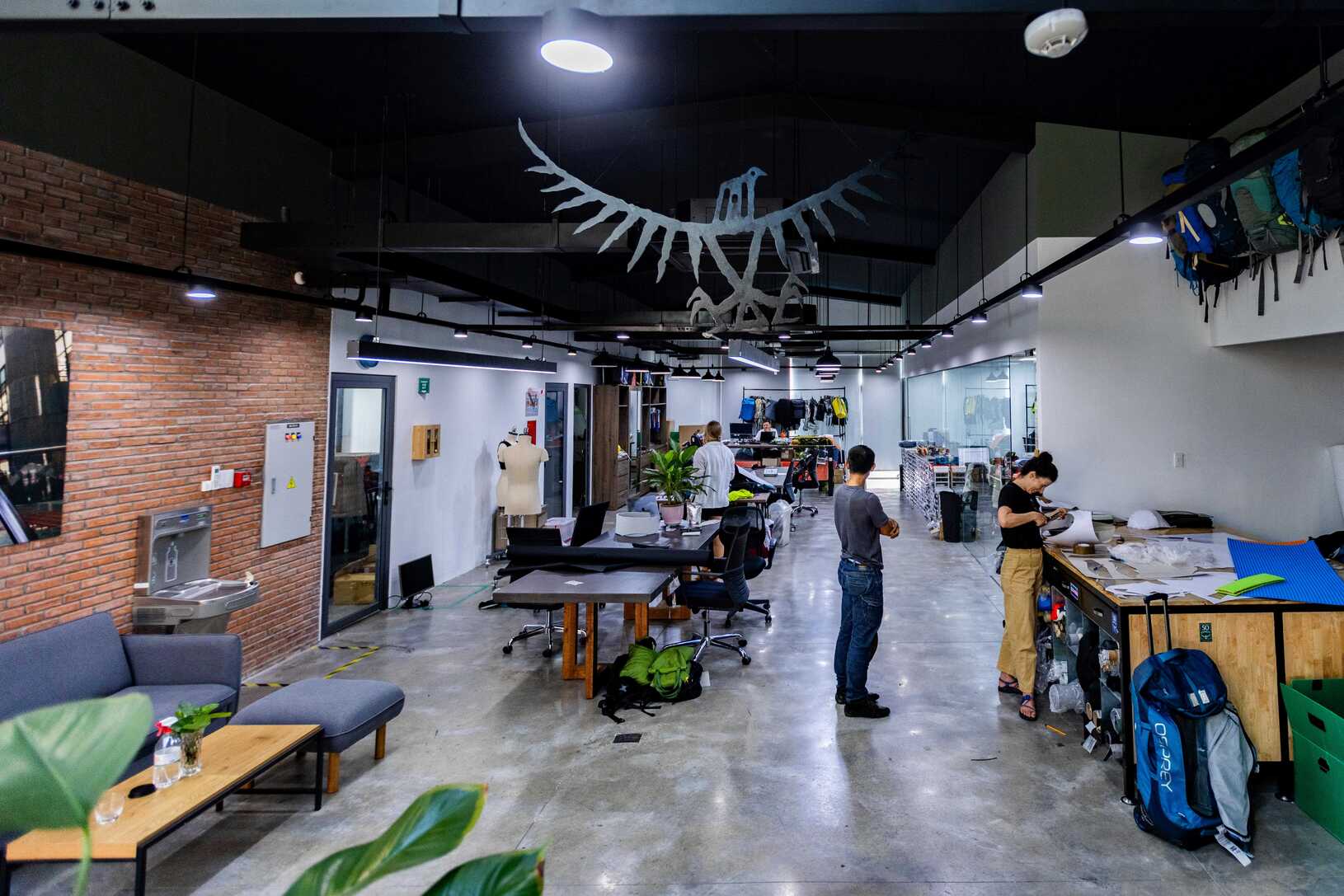
During my time in Ho Chi Minh city, I spent my final week working from Osprey’s office. In the previous weeks, I had explored Thao Dien’s numerous cafes while I worked remotely, only stopping into the office for occasional lunch with the team or evening silk painting lessons with Hien, one of Osprey’s graphic designers. My weeklong workspace at the office was on the third floor, which houses design and graphics. A glass wall partitions the desks from an open area with large tables and multiple walls hung with past products and current samples.
Two of Osprey’s longest tenured designers live and work from the Vietnam office: Le Nhu Quynh, Osprey’s design and innovation manager, and Guillaume Zaslavsky (Zed), a senior product designer. To begin my conversations with both designers, I asked them if a specific project or innovation in their time at the company excited them the most.
Zed asked me to pause the recording while he thoughtfully considered for a minute. “On a personal level,” he began, “I think something that was quite important to me was the Duro/Dyna project.”

This line of products at Osprey includes running vests and waist packs and was spearheaded by Zed. “I was still a fairly young designer within the company…probably there for like a year and a half,” he said, “I was still in this process of learning and I was asked to do a backpack, but I really insisted–I went all in–to try to convince people that we needed to invest [in running packs].”
At that time, Zed was doing a lot of trail running and saw an opportunity for Osprey to enter a new, growing market. He understood the importance of creating a space for Osprey in a category where they were non-existent. Many people at Osprey were reluctant to the idea, but still allowed him to test his theory to its fullest. Duro/Dyna is now a successful, evolving product line in the company.
“That was important, because for me I didn’t know how much trust people in the company were willing to put in my expertise or opinion,” he said, “and the company was smaller at the time…it was probably more easy, as a designer, to get your say on things than it is today. But young designers still have a lot of freedom [at Osprey] and each and every individual’s expertise is really valued.”
Zed also highlighted Osprey’s ongoing journey of sustainability as he considered my question about innovation. Osprey has a long history of sustainability, including their All Mighty Guarantee, which gives repairable products a second life at no cost to the consumer. This mindset is in place before a pack has even been designed, impacting how both designers and developers think about making something. In effect, sustainability is the starting point for every design. “We have, certainly, limitations that can be frustrating from time to time,” Zed said, “but ultimately when you remember the goal to make a pack that’s going to last, not fall apart, that’s repairable–it’s worth it.”

From design to materials to production, advancing sustainable practices is something the company invests in, and sometimes at a profit loss. “It’s going beyond, it’s going toward people who produce the yarn that mills use to weave the fabric,” Zed explained, “Not every brand can have that sort of weight to go into conversations with people like that…as a small brand, we still have this size that allows us to get into really interesting conversations with tier one, or two suppliers…We take it very seriously, and it’s something, personally, I really appreciate.”
As we continued our conversation, we began talking about the office and the team in Vietnam. “Hanh and Quynh and the pattern makers [are] very skilled individuals, even the sewing workers…they’re incredible specialists,” Zed said, “It’s a massive advantage, because, long story short, you can do more iterations. You can have daily conversations with specialists…all the kid carriers, for example, are insanely complex. There’s only a handful of factories that can really do that kind of work. And we have to prep all of that.”
I asked Zed what his perspective, as a designer, was when considering Osprey’s future. “We have to retain our core values of sustainability, durability, comfort…but sometimes we’re a bit chaotic,” Zed thinks for a moment, “For example, trying to limit the number of colors, which is good for every level. It’s good for decision making, it’s good for the supply chain, for the factories. It’s very efficient and I think in terms of our brand identity it will just help to reinforce it.”
“I think we already have the right philosophy. Whenever I’m trekking, you see a lot of people carrying Osprey packs and I often talk to them and you can feel genuine love of the customer, support for the brand,” He continued, “Despite the fact that we’re fifty years old…we’re still sort of a young big brand. A small brand at heart.”
Later that day, I spent some time with Quynh. I found him working on a paper model, cutting and taping a backpack harness design, stepping back to think, and returning to make adjustments. Quynh worked closely with Osprey’s founder, Mike Pfotenhauer, long before Osprey had their own office in Vietnam. “I was supposed to be an English teacher,” Quynh began, “But when I went to Ho Chi Minh City, I applied for a job at one of the factories that made many backpack brands, including Osprey.” His job was working as a translator, bridging the language gap between customers and the factory. He would synthesize requests for Vietnamese pattern makers and sewists and then follow up with the designers, which included Mike.

“I had a fever to create things and build things when I was young,” Quynh said, “So when I saw chances, I started to go ‘Oh, why don’t you do that?’ and talking to Mike and meeting with him.” Eventually, Quynh left the factory job for higher paying work at a steel company. When Mike came back to the factory and learned Quynh had left, he made the effort to contact him and ask if Quynh wanted to work at Osprey. Two months later, Quynh was working in Mike’s garage in Ho Chi Minh City.
I asked him what it was like changing from a small team sampling in factories to eventually building their own team for sampling. “A lot of things, when you build them, you realize that it doesn’t make sense,” Quynh explained, “Building with a factory…it may be two weeks, three weeks, until you see a sample.” For Mike and his small team, this pace didn’t match their iterative process. They wanted to innovate and find the solution to design problems before handing a product over to the factories. This led to the team’s natural growth over the years, including outgrowing multiple office spaces in Ho Chi Minh City. In 2019, the current office was built with a floor dedicated to each department.

I asked Quynh if there was a specific innovation he wanted to share with me for the blog series. He considered for a moment, then said, “There are many, many things. I am always amazed at how we found things, because when we’re searching [for an] idea we have a strong belief that the idea is good. Sometimes you don’t see it, but you keep looking…One of them was the Poco seat,” he continued, referencing Osprey’s award-winning Poco child carrier, “The leg hole [is] small, but when you push it down, the leg hole will open bigger…so you don’t have any buckle or anything, right? Because the mechanism of the hole…closes and opens by itself.” This innovation allowed the seat design to forgo buckles while still accommodating a growing child.
“Of course, I think the Atmos was more commercial and more famous,” He added, mentioning Osprey’s highly accoladed backpacking pack, known for its AntiGravity suspension system. “Often, [you get] more complicated and then in the end streamline to be very simple…that’s how it works, we kind of go from simple to very complicated…and kind of twist back. We have to accept that and give it some time,” Quynh said, “We always have something to learn.”
As a final question, I asked Quynh what his vision is for Osprey in the coming years. “I always say that it's to design durable with time and durable with place as well,” he answered, “Whatever we design, we should be thinking about that future…if we follow the trends, we will also be a trend…my aspiration is that I want Osprey to, at its core, keep innovating.”
Visit other floors of the Osprey Vietnam office: Operations & Quality Control(Opens in a new window); Sample Room(Opens in a new window)
Video player
Loading...
My Cart
Loading...